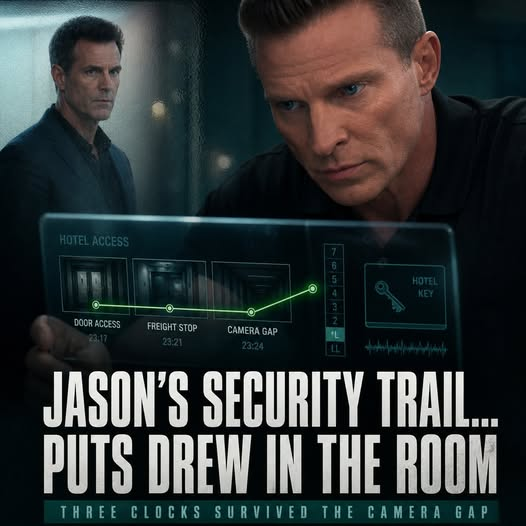
 Jason does not need a perfect camera image to place Drew inside Jack Brennan’s room. He only needs three records that were created by different systems: the door-access log, the service-elevator call history, and the surveillance outage window. Put those clocks beside Danny’s emergency call, and the blank space Drew expected to hide inside becomes a digital outline of his movements.
The first record answers who opened the room or reached its floor. The second shows how someone traveled away from it without using the public lobby. The third reveals when the hotel’s visual record failed. None proves the entire sequence alone. Together they can establish entry, movement, and concealment before Drew has time to reduce the night to a dispute about motive.
Jason and Carly confront the security danger surrounding Jack Brennan
The access log is more valuable than a missing video
Hotel cameras attract attention because they promise a face, a timestamp, and an obvious answer. Drew may have counted on surveillance trouble making the floor unreadable. Electronic locks operate differently. A key card, master credential, maintenance override, or failed entry attempt can remain recorded even when no useful hallway image survives.
Jason understands the value of that quieter evidence. He has spent years reading buildings as systems: entrances, exits, blind corners, staff routes, and the one door an opponent assumes no one will audit. He can ask which credential reached Brennan’s room, whether the lock cycled more than once, and whether any master access occurred during Ava’s distraction. A record tied to hotel personnel would not clear Drew; it would identify the person Drew needed to help or impersonate.
The timing also limits innocent explanations. If room access occurs while Brennan is away and immediately before his disappearance from the floor, Drew cannot easily call it routine. If the lock records no authorized guest entry, forced access or an override becomes part of the inquiry. Either result pulls attention toward the reason someone wanted Brennan separated from his possessions.
The freight elevator supplies the missing movement
The pool and Brennan’s room are two fixed locations. The unanswered problem is the path between them. A public elevator would create witnesses, so a freight or service lift offers the cleaner option. It also creates another record: call buttons, floor stops, door holds, maintenance alerts, or staff testimony about an unusual interruption.
Jason can compare the service-elevator clock with the room log instead of treating each system as isolated. A stop near Brennan’s floor shortly after unauthorized access, followed by a lower-level stop before Danny’s call, would establish a travel window. It would also identify which staff corridors deserve closer examination even if the cameras covering them went dark.
Jason follows the digital trail through Port Charles
The outage window can become evidence against Drew
A failed camera is not automatically proof of sabotage. Several cameras failing at the exact time a valuable room is entered and Brennan is moved creates a much more specific question. Investigators can determine when the system stopped reporting, whether the failure affected only useful zones, and when service returned. The shape of the outage can reveal whether someone disabled a network, interrupted power, or simply exploited a known blind spot.
Drew’s danger grows if the outage starts before the room entry. That order suggests preparation rather than panic. If it begins afterward, it suggests someone reacted when the search became harder to contain. Jason does not need to name the culprit before he maps the sequence. The order of failure, access, elevator movement, and emergency response is enough to decide whether the hotel problem was random or designed.
Danny’s call closes the far end of the timeline
Danny and Charlotte entered the situation without participating in the adult plan. That makes Danny’s call unusually clean. The dispatch timestamp records when the secret stopped being private, and the teens’ memories establish what the pool area looked like before Drew and Ava could coordinate every detail.
Working backward from the call gives Jason a maximum travel window. Working forward from the room entry gives him a minimum. If the two windows overlap with the elevator record and the camera failure, Drew’s alibi has to survive four independent clocks. One explanation cannot move those clocks without creating another contradiction.
That is why Jason’s search is more threatening than a confrontation. Drew can argue with Jason, question his motives, and try to turn the family against him. He cannot intimidate a lock server, an elevator controller, a camera-status log, and a dispatch record into remembering the same lie. The images may be missing, but the building still remembers the route.