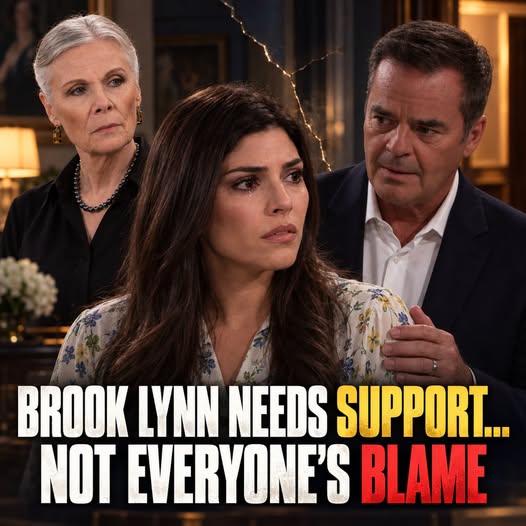
That distinction is more than a defense of a beloved character. It is the only way Port Charles can separate compassion from enabling. Ned and Tracy are right to stop Brook Lynn from becoming the town’s convenient container for every bad choice that followed. Their harder job is helping her face the consequences that actually belong to her without taking those away, too.
Brook Lynn’s silence did not make Curtis аttаck Isaiah
Curtis acted on the belief that Isaiah had caused the crash and damaged his family. That belief was wrong, but the decision to turn fury into violence remained Curtis’s. Portia said as much when Trina tried to connect Brook Lynn directly to his imprisonment. Even Trina understands that her father owns his action; her pain comes from knowing that an earlier truth could have changed the emotional conditions around it.
This is why blame must be precise. Brook Lynn can be criticized for staying quiet after she learned Jordan and Curtis had crashed. She can be challenged for letting another account harden while her own remained hidden. But she cannot be made responsible for an adult man’s decision to аttаck someone. If Port Charles collapses those choices into one, Curtis loses accountability and Brook Lynn receives a punishment that can never fit.
Family support is not the same as declaring her innocent
Ned’s instinct is to keep his daughter from breaking under the weight of a public reckoning. Tracy’s instinct is sharper and more defensive: protect the family first, manage the consequences later. Brook Lynn needs the warmth in the first instinct and the strength in the second. What she does not need is a family wall so complete that nobody can ask why she continued to hide the truth.
Ned already showed the healthier version of protection when he reassured Brook Lynn while still telling her she should not have been drinking and driving. He did not abandon her, and he did not pretend every part of the night was acceptable. That balance matters because support should make a confession possible. If it only makes consequences disappear, it becomes another reason to keep secrets.
The real cost belongs to the days after Route 91
Brook Lynn insists she did not know the other car had left the road. That is the dividing line between causing the crash and failing to come forward later. The Route 91 sequence places the first collision inside Jordan’s car, not in Brook Lynn’s hands. The later damage came from allowing uncertainty to keep spreading after she knew people were searching for answers.
That damage is personal before it is legal. Chase wonders whether he ever knew his wife. Gio questions whether Brook Lynn’s support for Trina was tangled with guilt. Trina looks at lost time with her family and sees a truth that arrived too late. None of those wounds prove Brook Lynn caused Curtis’s аttаck, but they explain why a simple declaration of innocence cannot restore trust.
Tracy and Ned can protect Brook Lynn by demanding repair
The strongest defense is not, “Brook Lynn did nothing wrong.” It is, “Brook Lynn will answer for her choice, and she will not answer for everyone else’s.” That gives Ned and Tracy a concrete role. They can stand between her and exaggerated blame while refusing to let shame become another hiding place. They can help her apologize without scripting the response she receives.
Brook Lynn has already chosen to face Trina even after Tracy tried to stop her. That decision matters because an apology offered without control is different from a defense arranged by powerful relatives. She cannot demand forgiveness, save her marriage in one conversation, or make Trina release years of anger. She can tell the truth without bargaining and accept that some people will need time.
The family also has to resist an old Quartermaine reflex: turning love into strategy. Brook Lynn’s relationship with Gio already carries the scars of decisions made in the name of protection. Her chance to stop Tracy from repeating an earlier maternal betrayal depends on showing that family loyalty can include honesty. Another cover story would only prove the harshest reading of their support.
General Hospital cast promotional image
Accountability should lead somewhere other than isolation
There is a cruel simplicity in making one person carry an entire chain: Brook Lynn stayed silent, therefore the crash fallout, Curtis’s violence, Trina’s grief, Chase’s walkout and Gio’s anger all belong to her. Soap families often accept that shortcut because it gives everyone a single target. It is emotionally satisfying for a moment and useless for repairing the relationships underneath.
A better reckoning assigns every choice to the person who made it. Jordan’s driving belongs to Jordan. Brook Lynn’s concealment belongs to Brook Lynn. Curtis’s аttаck belongs to Curtis. Tracy’s assistance belongs to Tracy. That does not shrink the tragedy; it makes honest repair possible. The same principle is why Jordan’s revelation divided crash responsibility instead of erasing it.
Brook Lynn needs someone to hold her while the people she hurt decide what comes next. She also needs someone who loves her enough to say that silence had a cost. Ned and Tracy can do both. The question is whether their protection gives Brook Lynn the courage to keep telling the truth—or becomes one more shield between her and the repair she has finally begun.