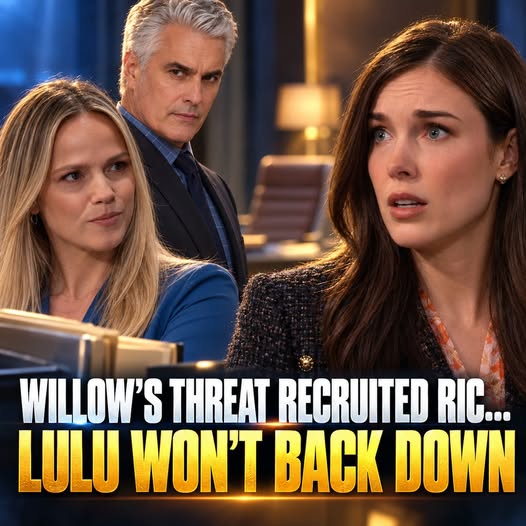
 Willow Tait wanted a retraction. Instead, her lawsuit has helped Lulu Spencer find someone willing to fight beside her. Ric Lansing has accepted Lulu as a client, turning the pressure meant to silence her into a reason to organize her defense. Willow can still insist that Lulu’s reporting damaged her reputation. What she cannot demand as easily is the cooperation she needs from everyone around it.
That is where this confrontation becomes dangerous for Willow. Lulu has a recording, a lawyer and a reason to hold her ground. Willow has anger and a clear demand, but several people whose words or choices could help her are moving in different directions. The most consequential gap belongs to Drew Cain.
Ric gives Lulu something a sympathetic friend cannot
Ric does more than listen to Lulu complain. He examines the lawsuit, hears her account and listens to her recording of Jenz Sidwell. His willingness to represent her gives Lulu a dependable person to help decide how she responds.
She no longer has to work out every risk alone while Willow presses for surrender.
His first strategy is pressure of his own: let Willow know Lulu intends to fight with Ric representing her, and see whether that makes the lawsuit less attractive. It is a bluff with a purpose, not a guaranteed escape. If Willow refuses to back down, Lulu still needs to support what she published. A lawyer can organize her defense; he cannot manufacture the missing support.
Ric Lansing and Lulu Spencer discuss her legal situation
Ric’s decision to represent Lulu gives her practical help as Willow demands a retraction.
That makes Ric’s question about Drew especially important. Why has Drew not backed up the allegations? Ric hears a lucid-sounding Sidwell on the tape, yet the person whose position could help clarify the dispute is not providing the confirmation Lulu wants. The recording gives Ric something to examine.
Drew’s refusal to support the accusation gives both sides a problem.
Drew is the ally Willow can least afford to leave ambiguous
Drew’s denial may look useful to Willow at first. If he rejects the allegations, she can point to a public disagreement with Lulu’s account. But a denial becomes much more useful when the person making it is prepared to explain himself consistently and answer difficult questions. Willow needs more than Drew being upset with Lulu. She needs his position to withstand scrutiny beside that recording.
If Drew actively helps Willow challenge Lulu’s reporting, he puts his own account closer to the center of the fight. He would have to confront the gap between what Sidwell said and what he is willing to support. That could strengthen Willow’s position if he supplies clear answers.
It also risks making every unresolved contradiction harder to brush aside.
If he keeps his distance, Willow loses something different: the force of a central figure openly helping her make her case. His refusal to back Lulu does not automatically become a complete defense of Willow. Silence leaves her carrying the demand for a retraction while Ric has room to keep asking why Drew will not go further. No new withdrawal of testimony has been shown; the vulnerability is cooperation that has yet to materialize.
Isaiah’s skepticism belongs in a different column
Isaiah Gannon’s caution about Sidwell cannot simply be counted as another person joining Willow’s side. When Joe Fitzpatrick asks about Sidwell and medication, Isaiah warns against taking Sidwell at face value.
That challenges easy confidence in the recording, but it does not establish that Lulu’s claims are false or that Willow’s version is true.
There is a difference between a doctor expressing skepticism, a witness supporting a particular account and an investigator deciding what to examine next. Joe’s interest in Brennan’s movements is an investigative step. Isaiah’s reservation is a reason for caution. Neither gives Willow the same kind of committed strategic help Ric has now offered Lulu.
Monet’s distance makes the shortage visible
Monet Mitchell supplies the clearest example of someone choosing distance from Willow for separate reasons. Her priority is Curtis and the public presentation of his appeal. Once she decides an association with Willow could hurt that effort, she says they cannot risk it. That is a decision about Curtis’s interests, not evidence of a coordinated campaign to punish Willow.
Still, its effect on Willow is personal.
She is demanding that Lulu repair her reputation while discovering that other people are already adjusting their plans around the damage. Monet can pursue Curtis’s publicity strategy without helping Willow. Ric can pursue Lulu’s defense against her. Drew remains the person whose fuller cooperation could matter most, precisely because his public position and Lulu’s tape pull apart.
Willow may yet force a harder fight over Lulu’s reporting. But a demanded retraction cannot replace a willing ally. Lulu now has Ric beside her to share the burden of a defense; Willow risks carrying her demand alone.