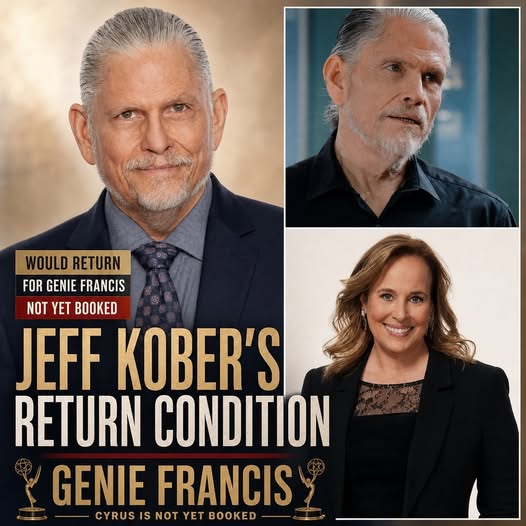
 Jeff Kober has not announced a return to General Hospital. He did, however, identify the condition that would make another visit to Port Charles personally irresistible: the chance to work with Genie Francis again. That distinction turns a familiar comeback rumor into something more specific. Cyrus Renault’s return door is open, but the name on the other side is Laura Collins.
Kober’s answer matters because Cyrus and Laura were never connected by ordinary νіllаіn-and-hero conflict. They are siblings whose scenes forced both characters to confront family, faith, resentment, and the possibility that blооd can create responsibility without creating trust. For Kober, that relationship appears to remain the unfinished center of Cyrus’s story.
Jeff Kober, the actor who portrays Cyrus Renault
A willingness to return is not a booking
The factual boundary is simple. Kober expressed enthusiasm about returning under the right creative circumstance. He did not say a contract was signed, production had called, scripts were written, or Cyrus had a scheduled air date. Viewers can take the interest seriously without turning it into an announcement the actor never made.
That boundary actually makes the comment more revealing. Kober did not give a generic answer about missing the cast or being open to any story. He named Francis. By selecting one performer, he pointed directly to the relationship he believes still has enough dramatic weight to justify another chapter.
If Cyrus returns without Laura at the center, the story risks repeating familiar beats: a threat arrives, old crimes are remembered, and Port Charles prepares for another betrayal. If Laura is the reason he comes back, the question changes. The conflict becomes whether either sibling can meet the other without falling into the roles they have spent years resisting.
Laura is the one person who can test Cyrus’s claimed transformation
Cyrus has repeatedly framed his choices through redemption, religion, and a desire for family. Laura can hear those claims without being disarmed by them. She knows his capacity for harm, understands the childhood wounds beneath his need for belonging, and refuses to confuse compassion with permission.
That makes her the ideal scene partner for a return. A police confrontation can measure whether Cyrus obeys the law. A mob confrontation can measure whether he remains dangerous. Laura measures whether the person he claims to have become can survive rejection, suspicion, and love that arrives with conditions.
Kober’s interest suggests he sees that test as dramatically unfinished. Cyrus can insist he has changed when strangers doubt him. It is much harder to make the claim while facing the sister whose forgiveness he has wanted and whose boundaries he has violated. Their scenes turn abstract redemption into a personal verdict.
Genie Francis, whose Laura shares a difficult sibling history with Cyrus
The timing gives the idea a new consequence
Laura’s current departure from Port Charles leaves a temporary absence at the exact moment several families are losing control. A Cyrus return during that absence would feel incomplete because the central reckoning could not happen. A later return timed to Laura’s reappearance would carry a built-in emotional event before any external plot begins.
That does not mean the show is planning such a pairing. It explains why Kober’s condition has more story value than a routine “never say never.” The actor named a relationship that already contains motive, memory, and consequence. Writers would not need to invent a reason for the two characters to matter to one another.
The same history also gives Laura power over the tone of a comeback. If she believes Cyrus is manipulating another crisis, the return becomes a warning. If she sees a genuine change that no one else accepts, the story becomes a test of her judgment. If Cyrus comes seeking help and reacts badly to a boundary, both interpretations collide.
Kober’s career milestone adds weight to the invitation
Kober’s work has recently been recognized across both daytime and primetime television, an unusual overlap that highlights the range he brings to Cyrus. That professional momentum makes his answer feel like a creative preference, not a performer waiting for any available call.
He can pursue roles outside Port Charles and still identify one General Hospital partnership worth revisiting. For viewers, that is the useful takeaway. Cyrus is not confirmed to return, but Kober has supplied a clear map for the version of the return he wants to play.
The door therefore remains conditional, not closed. It opens through Laura, through the sibling history neither character has resolved, and through the question that has always made Cyrus most dangerous: whether his need to be loved can survive being told no. Kober named the co-star. The show would still have to decide whether to walk both actors through that door.