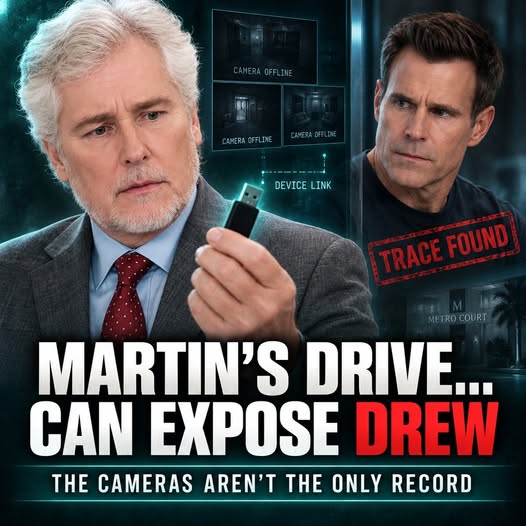
 Martin Grey may believe the Metro Court cameras erased Drew Cain’s most dangerous trail, but the flash drive changes that calculation. A dark screen is not the same thing as a clean operation. The physical device can connect the request for sabotage, the handoff, the system outage, and Drew’s access to Jack Brennan’s suite—and that chain starts forming long before anyone needs a confession.
The crucial question is not whether the missing video can somehow be restored. It is which part of the digital operation survived outside the cameras. If investigators can identify the drive, the computer that received it, or the moment the malicious program entered the hotel network, Drew’s carefully protected blackout becomes a timed window around his own movements.
The Flash Drive Is More Than a Convenient Plot Device
Martin supplied the digital tool after Drew needed a way around Metro Court security. Drew then used the program through Carly Spencer’s computer, knocking the camera system offline while he pursued whatever Brennan had hidden in his suite. Martin even raised a warning before the move. Drew answered with confidence that the operation would be seamless and that Martin would stay clear of the consequences.
That reassurance is now Martin’s biggest problem. He did not simply hear about a plan after it happened. He provided the object that made the blackout possible. Even if he never knew how far Drew’s scheme would go, his connection to the drive gives investigators a starting point that exists outside Drew’s version of events.
Chase and Joe compare the clues surrounding the Metro Court security failure
The Five Links That Can Rebuild a Missing Camera Window
Link one is the request. Why did Drew need a specialized security tool, and what explanation did he give Martin before receiving it? A message, call record, calendar entry, or witness to that conversation could establish intent without revealing every detail of the later plan.
Link two is the handoff. A flash drive is portable, but it is also physical. Martin had to obtain it, prepare it, and transfer it. That creates a chain of possession that can be tested against where Martin and Drew were before the Metro Court outage.
Link three is device history. Investigators do not need the drive to display a convenient confession. They would look for metadata, connection history, copies of the program, or traces left on the computer used to launch it. None of those records has been established on screen, but each is a logical forensic question created by the object itself.
Link four is the outage interval. Once the exact start and end of the blackout are known, the hotel stops being a place with no evidence and becomes a narrow timeline. Room access, elevator use, staff observations, laundry activity, and the breach of Brennan’s suite can be compared against the minutes when the cameras went silent.
Link five is Drew’s access. Drew admitted to Martin that his search of Brennan’s room came up empty, then dismissed the danger by insisting any leverage against him would stay buried. That statement does not prove the entire cover-up, but it places Drew’s own concern, his search, and the security sabotage inside the same sequence.
Martin’s Warning Can Protect Him—or Make His Position Worse
Martin can argue that he expected a digital trespass, not the fatal outcome surrounding Brennan. That distinction matters. It separates his knowledge from Drew’s later choices and from Ava Jerome’s role in Brennan’s final night. Martin’s warning also shows that he understood the operation carried legal risk before the drive ever changed hands.
Yet the same warning can cut the other way. If Martin knew the program would disable a working hotel system, he cannot easily pretend the drive was ordinary office equipment. The more Drew minimizes the plan, the more valuable Martin’s original caution becomes as evidence that both men understood what the tool was designed to do.
Drew has another reason to keep Martin exposed. Martin can connect him to the beginning of the blackout, while Drew alone knows what followed inside Brennan’s orbit. If pressure closes in, Drew may try to isolate the digital sabotage as Martin’s work and treat everything after it as a separate event. That is why Martin needs the full sequence before Drew supplies investigators with a simpler story.
Martin Grey faces the consequences of the flash drive handoff
Why the Security Blackout Can Become a Timeline Instead of a Void
The disappearance of video initially looks like Drew’s advantage. In practice, an unusual outage can draw attention to every system and human record around it. Detectives Chase and Joe do not have to solve the whole case from one recovered clip. They can begin by asking who benefited, which room was breached, and who had the means to silence the cameras at the precise time the hotel became vulnerable.
That inquiry also reaches beyond Martin. Jason and Carly found signs that Brennan’s suite had been searched. Drew moved with unusual urgency after his plan spiraled, and the cover-up created additional physical activity around the hotel. Each clue is incomplete alone. Joined to the drive, however, the clues become a sequence that is much harder to dismiss as coincidence.
This is the same weakness that appears in Drew’s attempt to redirect Brennan’s trail through Nina’s car: one planted or missing object cannot erase independent records. It also complicates what Carly and Valentin know about Brennan’s disappearance, because the outage can be timed against the moments when each person entered the story.
General Hospital cast promotional image
The Link Most Likely to Survive a Denial
The strongest link is likely to be the one neither Martin nor Drew can rewrite: an independent device or access record created at the time of the handoff and outage. Martin can deny knowing Drew’s full purpose. Drew can deny responsibility for what happened to Brennan. Neither explanation automatically erases a connection log, hotel access record, or copy of the malicious program found on a device tied to the operation.
That does not mean investigators already possess the decisive record. It means the flash drive gives them a disciplined route to search for it. Martin’s best chance is to explain the request and handoff before Drew turns him into the entire digital story. Drew’s best chance is to keep every surviving record separated. The instant Chase and Joe join those records to the missing-camera window, the blackout stops protecting Drew and starts measuring him.